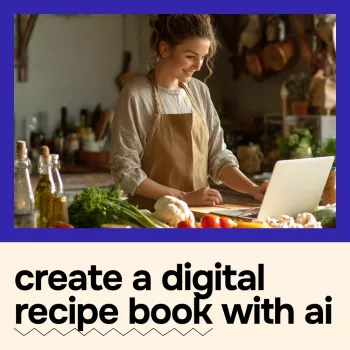
A digital recipe book starts with more than a collection of appealing dishes. You need a clear audience, recipes that work, and a format readers can use in the kitchen. AI can help you organize ideas and draft text, while your testing and editorial judgment turn those drafts into a dependable book.
Our AI digital recipe book step-by-step checklist, priced at $2.99, is a planning companion for creators who want to bring structure to that process.
Start With a Clear Recipe Book Concept
Begin by deciding who your book will help and what you want it to make easier. A collection of quick family dinners serves a different need than a beginner-friendly baking guide. The more specific your promise, the easier it becomes to choose recipes and leave out ideas that do not fit.
Use AI to brainstorm possible themes, recipe names, and chapter groupings. Then select ideas that suit your audience and your own cooking expertise. If your readers are beginners, for example, favor familiar ingredients and techniques you can explain clearly over complicated dishes that require specialized equipment.
Set a manageable scope for your first edition. Decide approximately how many recipes you can develop and test, whether you will include extras such as substitution notes, and which digital format you intend to publish. A short, carefully tested book can be more useful than a large collection of rushed recipes.
Build Your Recipe Book Checklist
Break the project into stages so you can see what remains before release. Use the table below as a working checklist, returning to earlier stages whenever testing reveals a change you need to make.
| Stage | Action | Creator check |
|---|---|---|
| Plan | Define the audience and recipe theme | The concept solves a clear reader need |
| Draft | Use AI to outline recipes and supporting text | Ingredients, quantities, and steps are complete |
| Test | Prepare each recipe and revise the instructions | Results are repeatable and food-safety guidance is sound |
| Design | Arrange recipes in a consistent digital layout | Text is readable and navigation is clear |
| Publish | Proofread, export, and review the final file | The book opens correctly on intended devices |
Our checklist is an affordable companion for organizing the journey from idea to finished digital book. Pair it with your own recipe notes, testing records, and publication schedule so you can track the decisions that matter to your project.
Draft With AI, Then Test Every Recipe
Ask AI to use a consistent recipe structure: a title, ingredient list with quantities, preparation steps, and suggested serving information. You can also use it to draft introductions or suggest ways to explain unfamiliar techniques. Keep your audience in mind when editing; a new cook may need more detail than an experienced one.
Treat every generated recipe as a starting draft, not a finished instruction. Cook each dish, measure the ingredients as written, and record what happens. Check whether the stated yield, preparation time, and cooking time match your results. If a step is confusing or a quantity needs adjusting, revise the recipe and test it again.
Verify food-safety advice independently. Generated temperatures, storage times, and allergy information can be wrong or incomplete. For cooked foods, consult the FoodSafety.gov safe minimum internal temperature chart and use the guidance relevant to the ingredients and preparation method. For allergy-related claims, check ingredient labels and avoid promising that a dish is safe for every reader.
Keep a simple record of changes between tests. That makes it easier to confirm that the version you publish is the one you actually prepared, rather than an earlier AI draft.
Design and Prepare the Book for Readers
Choose a layout that makes the next action easy to find. Use readable headings, distinct ingredient lists, and numbered steps in a consistent order. If your book has several chapters, a contents page can help readers find a recipe without scrolling through the entire file.
Consider how your chosen format will be used. A PDF may be convenient to download and print, while other digital formats may offer different navigation or display options. Export a sample early and review it on a phone, tablet, or other device your readers are likely to use. Look for tiny text, awkward page breaks, and links that do not work.
Use only photographs, illustrations, and other materials you have permission to include. Review the terms of any AI tools you use as well as the rights associated with outside materials. The U.S. Copyright Office’s AI resources offer a starting point for understanding questions around AI and copyright.
Before release, proofread the exported file—not just the editable draft. Check that every ingredient appears in the instructions, quantities are consistent, and recipe titles match the contents page.
Take the Next Step With Our Checklist
Whether you are planning your first collection or organizing a new edition, our step-by-step checklist for creators can help you give the project a clear structure. Visit the product page for current purchasing details; the listed price is $2.99.
If you also create resources for busy families, explore our No-Stress Packing Checklist for Traveling With Kids, another digital resource in our collection.
FAQ
Can you use AI to create AI?
Yes. AI can help developers write code, prepare data, and experiment with models, but people still need to evaluate and oversee the results. For a recipe book, AI is mainly a planning and drafting aid.
Can AI create a complete digital recipe book on its own?
AI can generate ideas and draft content, but you should test recipes, verify food-safety information, check permissions, and review the finished book.
What should creators check before publishing a recipe book?
Check recipe accuracy, food-safety guidance, permissions for included materials, proofreading, layout, and how the exported file works on intended devices.