Beat Imposter Syndrome: 10-Minute Checklist That Works

A Practical Guide to Overcoming Imposter Syndrome: An Actionable Checklist for Professionals, Creatives & Students
Imposter syndrome can show up right when momentum starts: a new role, a bigger client, a tougher class, a visible project. The goal isn’t to “erase doubt forever.” The goal is to build a repeatable system that helps confidence catch up to competence—especially on the days your brain insists you’re behind. Our team put this guide together as a simple, actionable checklist (with quick scripts and routines) that fits busy schedules and real deadlines.
Recognize the pattern (without turning it into your identity)
You don’t have to “solve” imposter syndrome to work with it. Start by treating it like a predictable pattern you can interrupt.
- Name the moment: identify what triggered the spike (feedback, presenting, posting your work, exams, performance reviews, comparing yourself to peers).
- Spot the familiar thoughts: “I just got lucky,” “They’ll find out,” “I’m not qualified,” “I need one more course/certification before I start.”
- Separate feelings from facts: anxiety is data about importance, not proof of incompetence.
- Watch for perfectionism disguises: over-preparing, avoiding shipping, endlessly revising, turning simple tasks into all-day projects.
- Notice the cycle: pressure → overwork/avoidance → short-term relief → more pressure. Our checklist below breaks the loop at multiple points.
The 10-minute reset: a checklist to use in real time
When the spiral hits mid-day, you need something you can do fast—without waiting for motivation. Try this once, then repeat it whenever the feeling returns.
- Step 1 (60 seconds): write one sentence: “The story my brain is telling is ______.” Keep it blunt and simple.
- Step 2 (2 minutes): list 3 facts that are true today (credentials, projects shipped, grades earned, deadlines met, people who chose to work with you).
- Step 3 (2 minutes): choose one tiny next action that proves progress (send the email, outline 3 bullet points, open the file, book the appointment).
- Step 4 (2 minutes): reduce the task to a draft, not a verdict. Decide what “good enough to move forward” means for this round.
- Step 5 (3 minutes): do a body cue reset—drink water, stand up, shoulders down, exhale longer than inhale for 5 cycles. Confidence follows action; action follows regulation.
Quick scripts to replace the automatic imposter loop
| Imposter thought | Grounded reframe | Next action |
|---|---|---|
| “I don’t belong here.” | “I’m learning in a room that matches my goals.” | Ask one clarifying question or take one note you can apply today. |
| “I got lucky.” | “Luck can open a door; skill keeps it open.” | Document what you did that worked (3 bullets) and repeat it once this week. |
| “If I need help, I’m failing.” | “Asking early is a professional skill.” | Send a specific help request with context + deadline + your proposed approach. |
| “If it’s not perfect, it’s embarrassing.” | “Shipping creates feedback; hiding creates fear.” | Publish/submit the v1 and schedule one improvement pass later. |
Build evidence: a confidence file that actually works
Your brain will argue with pep talks. It has a harder time arguing with receipts. Build a single “Evidence” file you can open in 30 seconds when your confidence drops.
- Create one home: a doc, notes page, or folder called “Evidence.” Keep it easy to access.
- Collect proof in three categories: outcomes (results, grades, metrics), process (habits, practice hours, consistency), and feedback (quotes from emails, reviews, messages).
- Run a weekly 5-minute audit: add one win, one lesson, and one next goal.
- Translate praise into specifics: if someone says “great job,” capture what you did that led to it (clear deck, solved a bug, revised a thesis statement, delivered on time).
- Read it like a neutral coach: not a prosecutor building a case against you.
Set standards that support growth (not burnout)
Talk to people without “confessing” your fear
Use the checklist daily: simple routines for professionals, creatives, and students
Put it all on one page: the printable, repeatable system
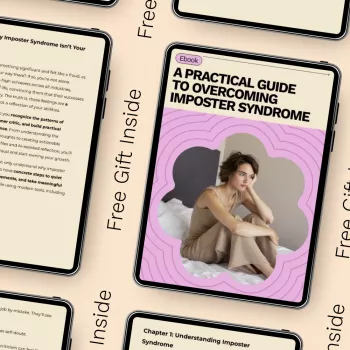
A checklist works best when it’s visible and easy to reuse—on your desk, in your planner, or as a pinned note. If you want the full one-page system our team built (reframes, step-by-step actions, evidence prompts, and feedback/boundary reminders), you can use our digital download: A Practical Guide to Overcoming Imposter Syndrome – Actionable Checklist for Professionals, Creatives & Students.
If you’re also trying to simplify other stressful systems in your life, our customers often pair checklists. Two popular options in our store are Waste Wise: A Home Recycling Guide | Simple Home Waste Sorting System for easier home sorting and No-Stress Packing Checklist for Traveling With Kids for reducing last-minute decision fatigue.
Helpful, research-informed perspectives
- American Psychological Association (APA) Dictionary of Psychology: Impostor phenomenon
- Harvard Business Review: Stop Telling Women They Have Imposter Syndrome
- International Journal of Behavioral Science: The Impostor Phenomenon (research overview)
FAQ
Is imposter syndrome a sign of low ability?
No—imposter feelings commonly show up in high-achievers and in moments where you’re stretching into new territory. Your emotions aren’t a reliable measure of competence, so use evidence tracking and calibrated feedback to ground your next steps.
How long does it take to overcome imposter syndrome?
It’s usually more realistic to treat it as a skill you learn to manage than a one-time problem you “finish.” With consistent practice—especially the 10-minute reset and a weekly evidence audit—many people feel noticeable improvement within a few weeks.
What if imposter syndrome is affecting my mental health or daily functioning?
If anxiety, depression symptoms, panic, or avoidance are persistent and disrupting your life, reaching out to a licensed therapist or counselor can be an important next step. Our checklist can support day-to-day coping, but it doesn’t replace professional care.










Leave a comment